


Periodontics
Meet Our Periodontics Specialist, Dr. Ghapure
Originally from Mumbai, India, Dr. Ghapure graduated Nair Hospital Dental College at the top of his class. After being awarded the Colgate Indian Dental Association Scholarship, Nair Hospital Dental College Student's Association Award, and the J.R.D Tata Scholarship for Academic Excellence, he accepted a position in the restorative dentistry program at Rutgers School of Dental Medicine in New Jersey. He then continued his education at a three-year specialty training program in periodontics and implant surgery at the University of Washington School of Dentistry, where he now works as an affiliate. Since then, his research has been featured in over twenty peer-reviewed articles; as well, he continues to practice implant therapy to this day.


Meet Our Periodontics Specialist, Dr. Yin
Dr. Yin received her dental degree from Guangxi University Medical School in China and moved to the United States as a postdoctoral research fellow at Columbia University Medical Center. To strengthen her foundation, she also obtained her master of science in biotechnology at Georgetown University. During all three years, she performed at the top of her class. Through her residency, she became adept in periodontal therapy, laser-assisted periodontal and peri-implantitis therapy, soft tissue grafting procedures, and implant-related surgeries. After residency, Dr. Yin continued as a fellow in the department of implant dentistry at Loma Linda University where she deepened her knowledge in prosthodontics, digital dentistry, full-mouth rehabilitation, and anterior implant esthetics.
Meet Our Periodontics Specialist, Dr. Kang
Dr. Kang received his doctor of dental medicine degree (cum laude) from the University of Nevada, Las Vegas School of Dental Medicine. He was then awarded with Omicron Kappa Upsilon Honorary Society, American Academy of Periodontology Dental Student Achievement Award, and Annual Award for Academic Achievement in the Biomedical Sciences. After moving to Seattle, he completed his master of science in dentistry and certificate of training in periodontics from the University of Washington School of Dentistry. As someone passionate about the artistry and engineering of bone and gum grafting, he has extensively studied how to prevent diseases brought on from dental implants.


Meet Our Periodontics Specialist, Dr. Chen
Dr. Chen obtained her dental doctorate degree from National Yang-Ming University in Taipei, Taiwan at the top of the class. She then completed five years of oral and maxillofacial surgery residency at Taipei Veterans General Hospital, where she received extensive clinical training in oral cancer, maxillofacial trauma, jawbone tumors, and orthognathic surgeries. After the training, she got certified by the Taiwanese Board of Oral and Maxillofacial Surgeons and was promoted to Attending Surgeon at Department of Oral and Maxillofacial Surgery, Taipei Veterans General Hospital. To excel in dental implant rehabilitation and periodontal bone reconstruction, Dr. Chen continued her education at the University of Pennsylvania, School of Dental Medicine and completed a three-year specialty training program in periodontics and implant surgery.
Meet Our Periodontics Specialist, Dr. Gilbert
After graduating with his Bachelor’s degree from Southeast Missouri State University, Dr. Gilbert enlisted in the army as a pharmacy technician, serving for six years before pursuing his degree in dentistry. He graduated from Case Western Reserve University School of Dental Medicine in 2004 at the age of 40, earning the CWRU Periodontics Award. He then rejoined the military, attending the US Army advanced education in periodontics program, graduating in 2008. He earned his Board Certification in 2009. He retired from the army in 2025 after 32 years of service, attaining the rank of colonel.

Dental Implants

Dental implants represent a remarkable breakthrough in the field of restorative dentistry. They have revolutionized the way we approach the replacement of missing teeth, offering a solution that closely mimics the form, function, and appearance of natural teeth.
Dental implants consist of three essential components: the implant itself, which is a small, biocompatible titanium post surgically placed into the jawbone; the abutment, which connects the implant to the crown; and the crown, the visible part of the implant that resembles a natural tooth. This three-part structure allows implants to provide a level of stability and durability that is unparalleled by other tooth replacement options.
One of the key advantages of dental implants is their ability to replace missing teeth without affecting adjacent healthy teeth. Traditional options like dental bridges require the alteration of neighboring teeth to support the bridge, which can compromise their long-term health. In contrast, dental implants stand independently, preserving the integrity of surrounding teeth.
Moreover, dental implants stimulate the jawbone just like natural tooth roots. This stimulation helps prevent bone loss, which can occur when a tooth is lost and its root is no longer present.
By preserving the bone structure, dental implants contribute to maintaining the facial contours and preventing the sunken appearance that can result from significant bone resorption.
Whether you are missing a single tooth, multiple teeth, or need a full arch of teeth replaced, dental implants offer versatile solutions. They provide a secure foundation for crowns, bridges, or even dentures, ensuring that your smile looks, feels, and functions naturally.
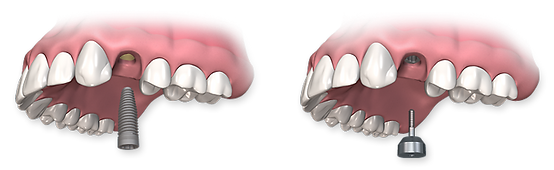

A dental implant is a titanium fixture that is placed into the bone under gums of the mouth. After the implant body is placed the implant will be left untreated for a period of 4-6 months. During this time, the bone will grow around the implant in a process called osseointegration.
The next step in the process is to attach an abutment to the tooth. This is achieved by exposing the top of the implant and placing the abutment. This is the part of the implant that will support the final crown.
Finally, an impression is taken of the implant and a final restoration is crafted. This restoration will be comfortable and cosmetically pleasing. Your completed implant will be fully functional, allowing you to resume normal activities.
At Light Dental Studios, we are committed to delivering exceptional dental services in a comfortable and welcoming environment. Your oral health and overall well-being are our top priorities, and our dedicated team is here to support you in achieving and maintaining a healthy, beautiful smile for life.
Laser gum therapy is a modern, minimally invasive treatment designed to target gum disease while preserving healthy tissue. Using precise laser technology, infected bacteria and diseased tissue are gently removed without the need for traditional scalpels or sutures.
One of the biggest benefits is comfort. Patients typically experience less bleeding, reduced swelling, and minimal discomfort both during and after the procedure. Because lasers promote natural clotting and sterilize the area as they work, healing is often faster and the risk of infection is lower.
Laser gum therapy is also highly precise, allowing clinicians to treat problem areas while protecting surrounding healthy gum tissue. The result is a more comfortable experience, shorter recovery time, and improved long-term gum health, helping patients maintain a stronger, healthier smile with less downtime.
